
How to Get More Trustpilot Reviews From Every Customer
· Updated · Scanlo Team
Contents
- What Trustpilot actually lets you do
- Why a review is worth more than it was two years ago
- Where the ask belongs
- Use the link that opens the form, not your profile
- The part almost nobody does: find out which placement worked
- If you collect reviews in more than one place
- A setup you can run this week
- Frequently Asked Questions
- Bottom line
Quick answer
Ask every customer, not just the happy ones. Trustpilot allows QR code and link invitations but prohibits picking who you invite and prohibits incentives, so the ask belongs somewhere every customer passes: the receipt, the packing slip, the invoice, the counter. Then track which of those spots actually earns reviews.
A review is the cheapest asset a small business will ever build. The price is one question, asked at the right moment. The return is a line of text with a stranger's name on it that keeps working for years, on your Trustpilot profile, in search results, and increasingly inside the AI answers your next customer reads instead of a search page.
Almost nobody asks. That is the whole opportunity. The businesses with 400 reviews are rarely 400 times better than the ones with three; they built a habit of asking, and they put the ask somewhere it could not be forgotten.
The hard part is not the wording. It is the placement, and Trustpilot's own rules decide more of it than most people realize.
What Trustpilot actually lets you do
Start here, because half the advice on this topic quietly recommends something Trustpilot bans.
QR codes are explicitly allowed. From Trustpilot's guidelines for businesses: "Businesses can invite customers using automated or non-automated invitations (like sharing links or QR codes), provided reviews are collected in a way that is fair, neutral and in line with our guidelines."
Cherry-picking is not. The same guidelines list, under what a business must not do: "Be selective with invitations, by picking and choosing which customers you invite. This includes inviting only those people who you know have had a positive experience." They go further and rule out the sneaky version of the same thing, setting invitations to fire at a point in the customer journey that only happy customers ever reach.
Incentives are not. No discounts, promo codes, prize draw entries, refunds, freebies, or any other benefit connected to leaving a review. In the US this is also federal law now: the FTC's Consumer Reviews and Testimonials Rule, effective October 21, 2024, bans incentives conditioned on the sentiment of a review.
Read those three together and they are not really a compliance burden. They are a design brief. If you cannot choose who gets asked, and you cannot pay for a yes, then the only variable you control is where the ask sits. It has to sit somewhere every customer passes, and it has to be easy enough to act on in the ten seconds of goodwill you get.
That is exactly what a QR code on a receipt is.
Why a review is worth more than it was two years ago
Reviews always did two jobs: they reassured the person reading your profile, and they fed the star rating that shows up next to your name.
They have quietly picked up a third. When someone asks an AI assistant whether your company is any good, the assistant does not have an opinion. It goes looking for what other people wrote about you, and the pages it reaches for are overwhelmingly ones you do not own: forums, Q&A threads, directories and review platforms.
Be careful with the numbers floating around this. Trustpilot's own reporting says it is now the fifth most cited domain on ChatGPT with citations up 246%, and their marketing puts it at "up to 58% of review citations". Those are Trustpilot's figures about Trustpilot. Independent studies land in a wider range: a 2026 index built from several of them puts Trustpilot inside the top 50 cited domains but well below Yelp and G2, and Semrush's thirteen-week study of 230,000 prompts does not surface it at all. Reddit, not any review platform, is the one source every study agrees on.
The honest version, which is enough for a decision:
AI answers about a business are assembled mostly from third-party content the business does not control.
Review platforms are inside that set, in every study, at every magnitude.
You cannot optimize your way into it. You can only make sure there is something there to find.
That is a strange kind of marketing channel. There is no budget, no campaign and no dashboard. There is only a stock of real reviews, built one at a time, and it either exists on the day someone asks about you or it does not. A review you collect this month is still working in 2028.
Where the ask belongs
Rank your options by one question: does every customer pass this, or only the ones who were already delighted? The first kind is compliant and compounding. The second kind is against the guidelines and, worse, it lies to you about how you are doing.
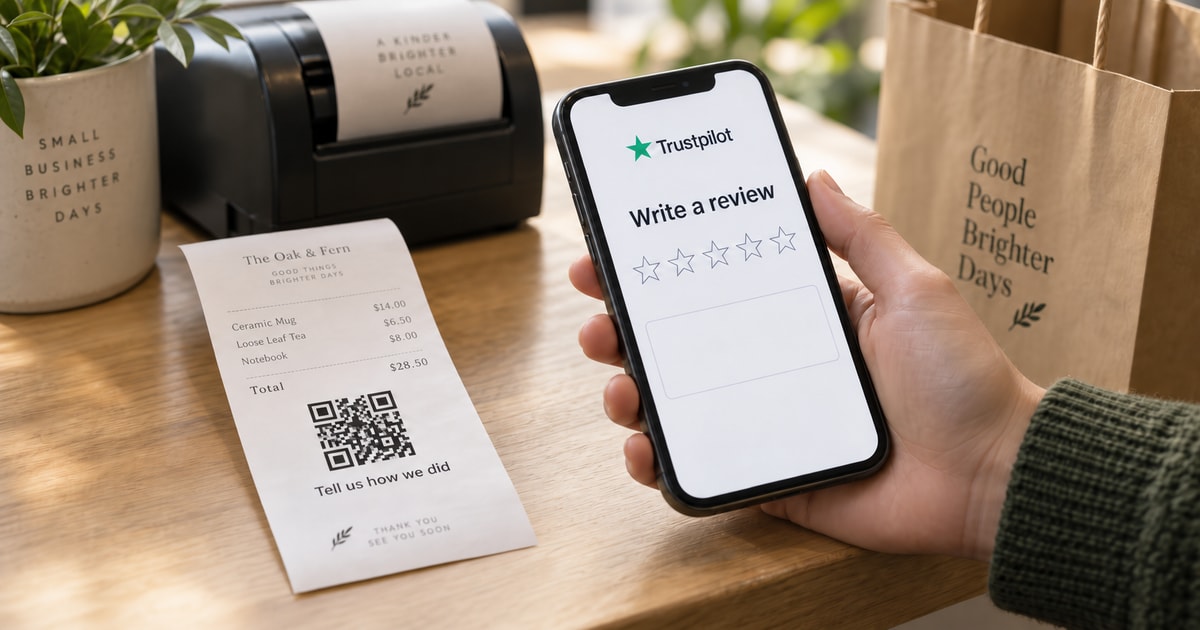
On the receipt. The best one for most counter businesses. Every paying customer gets it, it costs one line in your receipt printer settings, and it arrives at the exact moment the transaction closed well. All it takes is adding a QR code to the receipt.
On the invoice. The service business version. A trades invoice, a consultancy invoice, or an order confirmation is the most-read document you send, and a small code in the footer rides along free.
In the parcel. E-commerce and takeout. A card in the box or a sticker on the bag reaches the customer at the actual peak of the experience, which is the unboxing or the first bite, not the moment they paid.
On the thing you already hand over. Restaurants are the clearest case. The wrapped mint or candy that arrives with the check, the coaster, the napkin band, the paper sleeve. It is already printed, someone already touches it, and the marginal cost of the ask is a QR code in the corner of the artwork.
On the counter. Useful, but weaker than it looks: a counter card reaches whoever chooses to look at it, which skews to people in a good mood. Fine as a supplement, poor as your only channel.
On your website. Your order confirmation page and your account page are seen by every customer by definition. Scanlo's website embed shows the same tracked code live on your site, so desktop visitors scan it with their phone and phone visitors tap it, and your dashboard splits those scans from the printed ones. That split is on every plan.
On the door or the van. Reaches people who never bought anything, which makes it the weakest of the set for reviews and a better fit for a booking or payment code.
Through the SMS after the visit. If you already collect customer data like a phone number along with necessary consent, you can use that to send out simple SMS campaigns with thank-you notes/review requests using a medium that has 98% of open rate. There are dedicated products that could help you with that, and Remindlo (our sister brand) is one of them.
One rule about timing cuts across all of these. Ask when the job is done and visibly good: the meal eaten, the boiler fixed, the parcel opened. Not before, and not three weeks later, when the customer has to reconstruct how they felt. For walk-in businesses that means asking before the customer walks out, because "I'll do it later" usually becomes never.
Use the link that opens the form, not your profile
A small detail that costs a real share of the reviews you would otherwise get.
Your Trustpilot profile page (trustpilot.com/review/yourdomain.com) is where people read reviews. The evaluate link (trustpilot.com/evaluate/yourdomain.com) is where people write one. Point your code at the evaluate link and the customer lands on the write-a-review form with the star selector already in front of them. Point it at your profile and you have asked them to find the button themselves, on a phone, standing up, with a bag in their other hand.
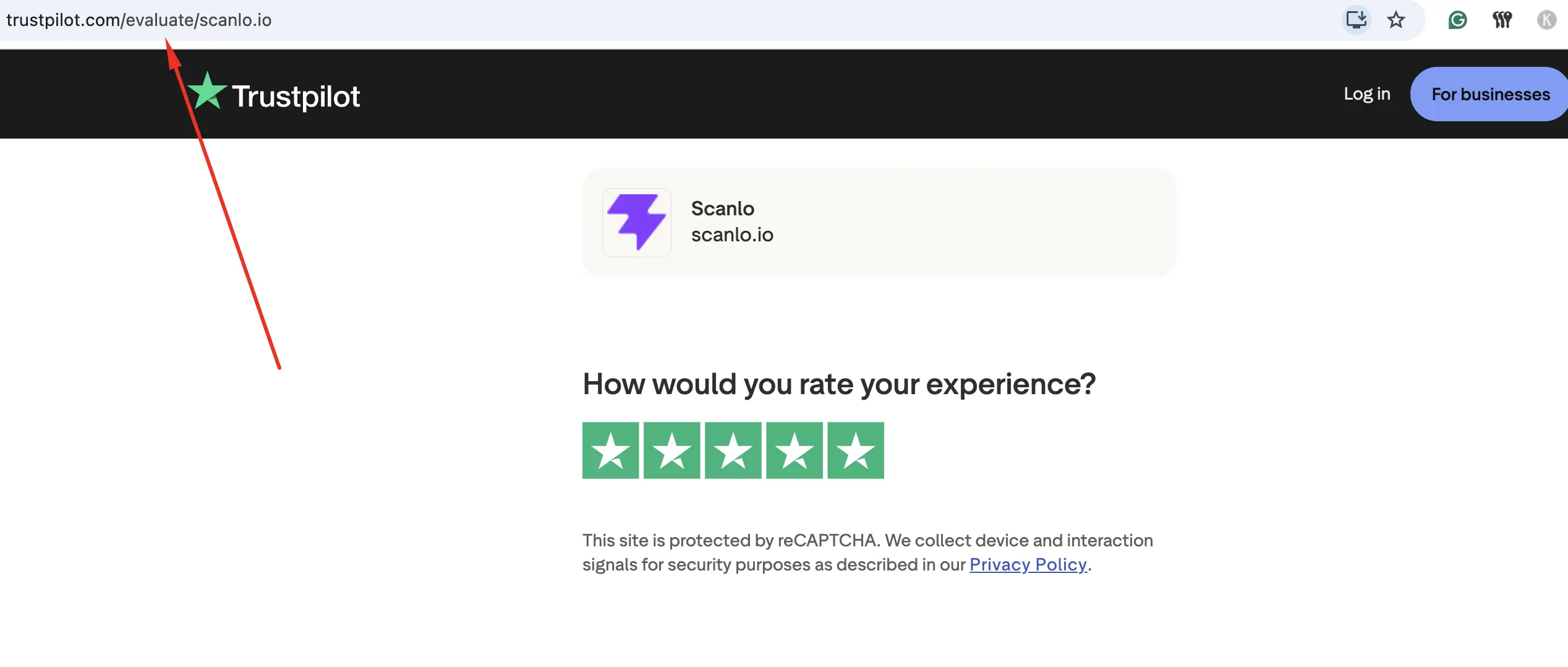
Every extra tap between the scan and the stars costs you reviews, and this one is free to remove.
The part almost nobody does: find out which placement worked
Here is the uncomfortable question. You put the code on the receipt, on the counter card and in the parcel. Six weeks later you have nineteen new reviews. Which of the three earned them?
Most businesses cannot answer, so they keep paying for all three and learn nothing. The fix is not complicated: make a separate tracked QR code per placement, all pointing at the same Trustpilot evaluate link, and label them by where they go.
receipton the receipt footercounteron the acrylic standparcelon the insert card
Every scan is logged against the code that produced it, so at the end of the month you have three numbers instead of one. When the parcel insert is doing four times the work of the counter card, you print more inserts and stop reordering stands.
Two honest limits, because this is where competitors overclaim.
We count scans, not reviews. Trustpilot does not tell anyone which invitation produced which review, so nobody can hand you a per-placement review count, us included. What you get is the number of people who took the ask seriously enough to open the form, which is the closest measurable proxy that exists and is far more than the zero you have today.
Watch out for the visibility trap. A code in a busy doorway will out-scan a code on an invoice while producing worse reviews, because a scan from someone who never bought anything is not a review opportunity. Compare placements that reach actual customers against each other, not against footfall.
Scan totals and a 30-day history are on the free plan, which covers a first test. Comparing placements side by side is part of Standard.
If you collect reviews in more than one place
Plenty of businesses want reviews on Trustpilot and on Google, and the temptation is to print both codes side by side. Do not. A phone camera locks onto whichever code is nearest, so half your customers land on the platform you did not mean, and neither code tells you anything about the other.
Three workable options instead.
One code, a page that lists them. A review hub is a single QR that opens a short page with a button per platform, so the customer picks the one they already have an account on instead of a camera picking for them. This is the option that scales past two platforms, and it is the one to use if you are being told to collect on Google, Facebook, Trustpilot, Yelp and BBB at once.
Split by channel. Trustpilot on the invoice and the parcel, Google on the counter card and the van. Each code stays a single code, each has a job, and the numbers stay clean.
Split by time. Run Trustpilot for a month on every placement, then Google for a month, and compare. Because a Scanlo code encodes its own short URL rather than the destination, you repoint the same printed code from one platform to the other without reprinting anything. The pixels do not change when the destination does.
The second option is also the answer to the question everyone asks eventually, which is what happens when you change review platforms. The print you already handed out stays valid.
A setup you can run this week
Get your evaluate link.
trustpilot.com/evaluate/yourdomain.com. Open it on your own phone first and make sure it lands on the form.Make two tracked codes, both pointing at it, labeled by where they will live. Two is the free plan, and two is enough to learn something.
Put them where every customer passes, not where the happy ones linger. Receipt or invoice first, parcel or packaging second.
Say nothing clever. "Tell us how we did" next to the code. No stars in the artwork, no "leave us a 5-star review", no discount. Both Trustpilot's guidelines and the FTC rule are about steering, and steering is the thing to avoid.
Wait three weeks, then look. Which code moved? Print more of that one. Move the loser somewhere else and give it another three weeks.
Add the ask to something you already print. The goal is that nobody has to remember to ask, because the asking is built into paper you were producing anyway.
👉 Create a free Trustpilot review QR code with Scanlo 👈
Frequently Asked Questions
How do I get more Trustpilot reviews?
Ask every customer, at the moment the job is visibly done, through something they already receive. In practice that means a QR code or link on the receipt, invoice, packing slip or packaging insert rather than a one-off email campaign. Volume comes from the ask being automatic, not from the wording.
Can I use a QR code to ask for Trustpilot reviews?
Yes. Trustpilot's guidelines for businesses state that businesses can invite customers using automated or non-automated invitations "like sharing links or QR codes", as long as reviews are collected in a way that is fair and neutral. The code should point at your evaluate link so it opens the write-a-review form.
Can I offer a discount or a freebie for a review?
No. Trustpilot prohibits incentives connected to leaving a review, including discounts, promo codes, prize draw entries, refunds and freebies, and will remove incentivized reviews and act against the business. In the US the FTC's Consumer Reviews and Testimonials Rule also bans incentives conditioned on the sentiment of a review.
Can I ask only the customers I know are happy?
No, and this is the rule most businesses break by accident. Trustpilot prohibits picking and choosing who you invite, including inviting only people you know had a positive experience, and prohibits timing invitations so they only reach customers who had a good experience. If you cannot invite everyone, use an impartial system such as every third customer.
Which Trustpilot link should my QR code point at?
The evaluate link, trustpilot.com/evaluate/yourdomain.com. It opens the write-a-review form directly. Your profile page is for reading reviews, and pointing a code there adds a tap and a decision between the scan and the stars.
How do I know which placement is bringing the reviews?
Create one tracked code per placement, all pointing at the same evaluate link, and label them (receipt, counter, parcel). Scanlo logs every scan against the code that produced it, so you can compare spots. Note that no tool can attribute a specific review to a specific placement, because Trustpilot does not expose that; scans are the measurable proxy.
What happens to my printed codes if I stop paying?
They keep working. A printed Scanlo code keeps redirecting forever, on any plan, and scans keep being logged after a downgrade or a cancellation. Only editing is locked. Nothing you printed and handed to a customer breaks because of a billing change.
Bottom line
Reviews are the rare asset that costs almost nothing to build and never stops paying. The reason most small businesses have six of them is not that their customers are unhappy. It is that the ask lives in somebody's head instead of on the receipt.
Trustpilot's rules point at the same conclusion from the other direction: you may not choose who gets asked, so put the ask where everyone passes. Then track which of those places is actually doing the work, so that in three months you are printing the thing that earns reviews and not the thing that felt like a good idea.
👉 Create a free Trustpilot review QR code with Scanlo 👈
Related reading: why one QR code beats four on a counter sign if you are deciding what a single piece of print should do, and one QR code for every review site if you collect on more than one platform.