
Can One Bad Review Ruin a Business? What a Year-Old 1-Star Taught Me
· Peter Bednarek
Contents
Quick answer
One bad review rarely ruins a business, but it can follow one for a long time. On a small profile it drags the average down: a single 1-star after ten 5-stars takes you from 5.0 to 4.6, and it takes 19 more five-star reviews to climb back to 4.8. On any profile, Google may keep showing it first in the default "Most relevant" view long after newer, better reviews arrive. The fix is a steady flow of reviews, collected before you need them.
A few days ago I was looking at the Google profile of a business I know: a home-furnishing showroom in Western Europe with about 70 reviews and a 4.2 rating. Good business, mostly happy customers, a steady trickle of five-star reviews.
Then I looked at what a first-time visitor actually sees when they open the reviews.
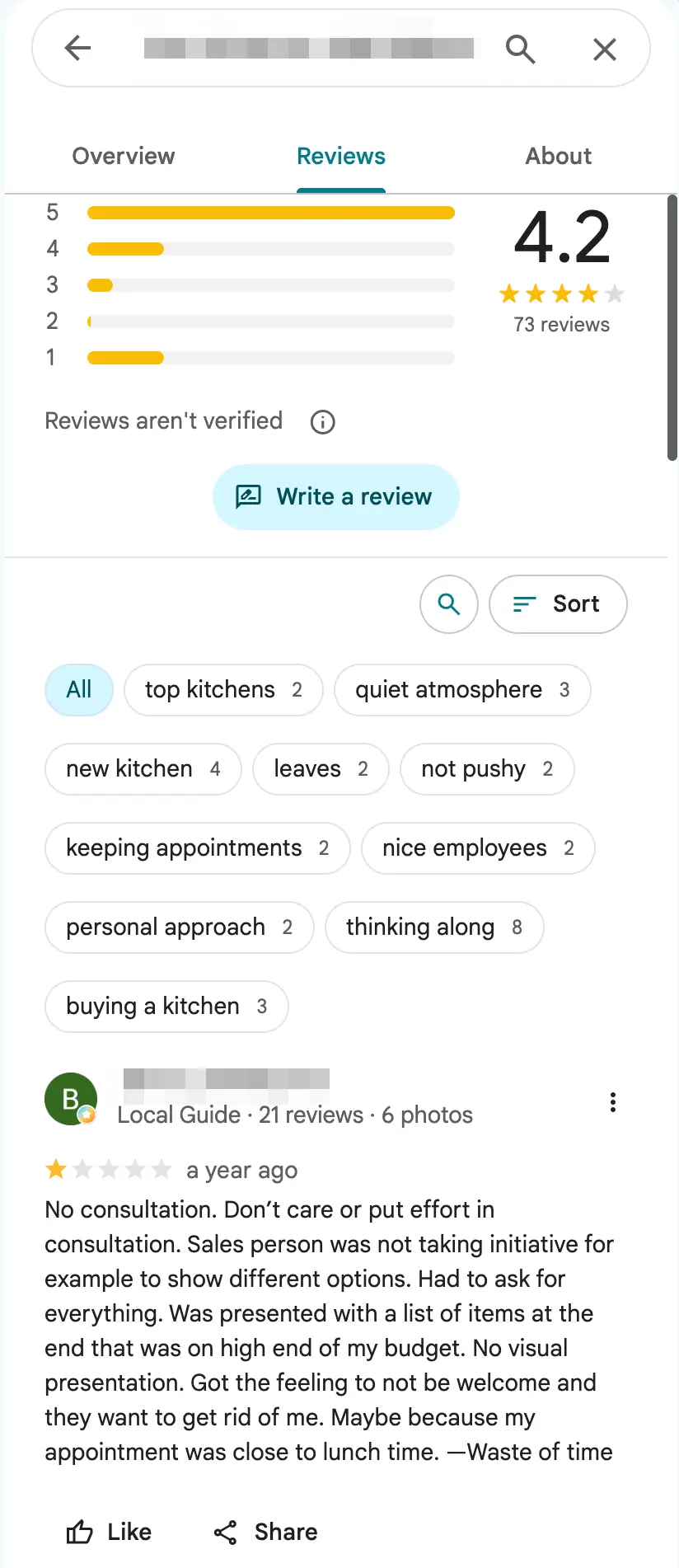
Google review summary showing a 4.2 average with a year-old one-star review shown first in the default view
The first review on the list is a one-star, written a year ago. The customer felt ignored during a design consultation: nobody offered options, they had to ask for everything, and the final quote landed at the top of their budget. They guessed it was because their appointment was right before lunch.
Now sort the same reviews by newest. There are ten reviews newer than that one-star, and every single one of them is five stars. The most recent was left the day before I looked, with photos of a finished kitchen.
None of that is what a new customer sees first. They see the lunch-break consultation.
Why Google shows an old bad review first
Google's default review order is not newest first. It is "Most relevant", and Google does not publish how relevance is decided. So what follows is what I can see, and then what I think, kept apart.
What I can see:
The one-star is a year old and sits above ten newer five-stars.
It is long and specific. Most of the five-stars after it are short.
Its author is a Local Guide with about twenty reviews and some photos.
My read (not documented anywhere):
Reviewer history probably counts. A Local Guide with a track record is a more credible voice to Google than a first-time reviewer, and that likely carries weight in the ranking.
Detail beats stars. "Top service!!" tells the next customer nothing. A paragraph about what went wrong tells them a lot, so a relevance model has a reason to surface it.
A wall of fives is not useful to Google. Ten identical five-stars look like noise, or worse, like a curated list. A critical review in view makes the whole profile look honest, and it keeps people reading.
It nudges the owner to act. A business that sees its worst review on top has every reason to collect more reviews, and more reviews are more content on Google's maps.
You do not have to believe any of the last four. The first list is enough: the review a new customer reads first is not chosen by date, and you do not choose it.
What one bad review does to your average
The second cost is arithmetic, and it is harsher the smaller you are.
Your reviews | Add one 1-star | New average |
|---|---|---|
5 reviews, all 5-star | 1-star | 4.3 |
10 reviews, all 5-star | 1-star | 4.6 |
20 reviews, all 5-star | 1-star | 4.8 |
40 reviews, all 5-star | 1-star | 4.9 |
Read that table the other way and it tells you how many five-star reviews it takes to absorb one bad one:
19 five-stars to average 4.8 again.
39 five-stars to average 4.9.
That is the part people underestimate. A one-star from a customer who caught you on a bad day costs one afternoon to earn and months of good service to bury, if your happy customers actually leave reviews. Most of them will not unless someone asks.
The showroom shows the other side of the same math. At about 70 reviews, that single one-star moves the average by only about 0.04. Its average damage is small. Getting from 4.2 to 4.5 is a different story: roughly 40 to 50 consecutive five-star reviews, at the pace they come in now.
So a bad review has two costs, and they hit different businesses:
Small profile: the average. Every review is a big share of the score.
Any profile: placement. The review a newcomer reads first may be your worst one, regardless of how many you have.
Why the average matters beyond the stars
The rating is not only what a customer sees after they find you. It also shapes whether they find you at all.
Google's own help page on local ranking says review count and review score are part of how it ranks businesses in local results. Drop a few tenths and you can slide down the map pack for the searches that bring in new customers, at the exact moment you were relying on them. I wrote about how fragile that dependence on Google is in what a core update did to our traffic, and why you should own your customer list. The review profile is the same lesson in a smaller box: a number Google controls, built from material only you can supply.
What to do about a bad review you already have
You cannot delete it, and in most cases you should not try to get it removed. Unless it breaks Google's content policies (spam, fake, off-topic, offensive), it stays. Three things you can do:
Reply, once, calmly, and publicly. Every newcomer who reads the review reads your reply right under it. Acknowledge the experience, say what changed, and offer a direct contact. Do not argue the details. The reader is not the reviewer; it is the next customer.
Fix the thing, if it is real. In this case the complaint is not about the product. It is about a consultation that felt rushed. That is a scheduling and training problem, and it is cheap to fix.
Make the review a minority. You cannot move it off the page, but you can make it one voice among many recent ones, so the newcomer who reads it also reads why fifty other people were happy.
The third one is the only one that scales, and it only works if it was already running before the bad review arrived.
Collect reviews before you need them
Reviews are like savings: the time to build them is when nothing is wrong. Once the bad one lands, every happy customer you never asked is a review you cannot get back.
That means making the ask routine, for every customer, not only the ones who seem delighted. Asking only the happy ones skews your profile and breaks some platforms' rules. The simplest routine is a code where the customer already is: on the counter, on the invoice, on the delivery note, on the card you leave after an install. One scan opens the write-a-review form. More on the timing in when to ask for a review.
And measure it. Give each spot its own tracked code, all pointing at the same review link, named for where it lives (counter, invoice, install-card). After a few weeks you will know which spot customers actually use. One honest limit: we count scans, not reviews. Google does not tell anyone which invitation produced which review, so a scan, meaning someone opened the form, is the closest proxy there is. Put it next to the new-review count in your Business Profile each month.
👉 Create a free Google review QR code with Scanlo 👈
Frequently Asked Questions
Can one bad review ruin a business?
Rarely on its own, but it can cost more than it looks. On a profile with few reviews, one 1-star can drop the average by several tenths, which affects both what customers think and where you rank locally. On any profile, Google may keep showing it near the top of the default view for a long time.
Why does Google show an old negative review first?
The default sort is "Most relevant", not newest. Google does not publish how it decides relevance. In practice, detailed reviews from established reviewers, such as Local Guides, often stay near the top regardless of age. Customers can switch to "Newest", but most first-time visitors do not.
How many 5-star reviews does it take to offset a bad review?
It depends on where you start. If all your other reviews are five stars, it takes 19 five-star reviews after a single 1-star to average 4.8 again, and 39 to reach 4.9. Starting from a lower average, it takes more.
How do bad reviews affect a business?
Two ways. They lower the average rating, which Google uses as one of its local ranking factors, and they shape the first impression of anyone who reads your reviews before visiting or calling.
Should I respond to a bad review?
Yes, once, politely and publicly. Your reply is shown directly under the review, so write it for the next customer, not the reviewer: acknowledge the experience, say what changed, and give a way to reach you directly.
Can I get a bad Google review removed?
Only if it violates Google's content policies, for example spam, fake engagement, off-topic or offensive content. A genuine negative experience, even one you disagree with, is not a policy violation.
What happens to my printed codes if I stop paying for Scanlo?
They keep working. A printed Scanlo code keeps redirecting forever, on any plan, and scans keep being logged after a downgrade or a cancellation. Only editing is locked.
Bottom line
One customer's bad hour can stay on your profile, near the top, for a year or more, while ten happy customers after them sit underneath. You do not get to pick which review Google shows first. What you do get to pick is how many voices that review sits among.
Start collecting reviews when nothing is wrong. Ask everyone, at the moment they are with you, and make it one scan. When the bad one comes, it will land in a crowd.